Figure reports Helix 2.5 humanoid model reaches 56% zero-shot success in 30 new homes
Figure said on 17 September 2026 that Helix 2.5, pretrained on its Index human dataset, completed household tasks in 30 unseen homes 56% of the time zero-shot.
By Emre AlemdarPublished
 Tech AI Latest
Figure published results for Helix 2.5 on 17 September 2026, its humanoid robot model pretrained from scratch on Index, a dataset of human behaviour. Tested zero-shot in 30 Bay Area homes it had never seen, the model completed tidying, towel folding and bed making 56% of the time, against 9% for the same model trained without Index pretraining. Figure also reports a scaling law that predicted test loss before training.
Key facts
- Published: 17 September 2026 (Figure)
- Test: 30 unseen Bay Area homes, no data collected in any of them, one fixed checkpoint per task
- Tasks: living room tidy, towel folding and bed making
- Zero-shot success: 56% with Index pretraining, 9% when trained from scratch
- Matched a Helix 02 policy's success rate with half as much adaptation data, Figure says
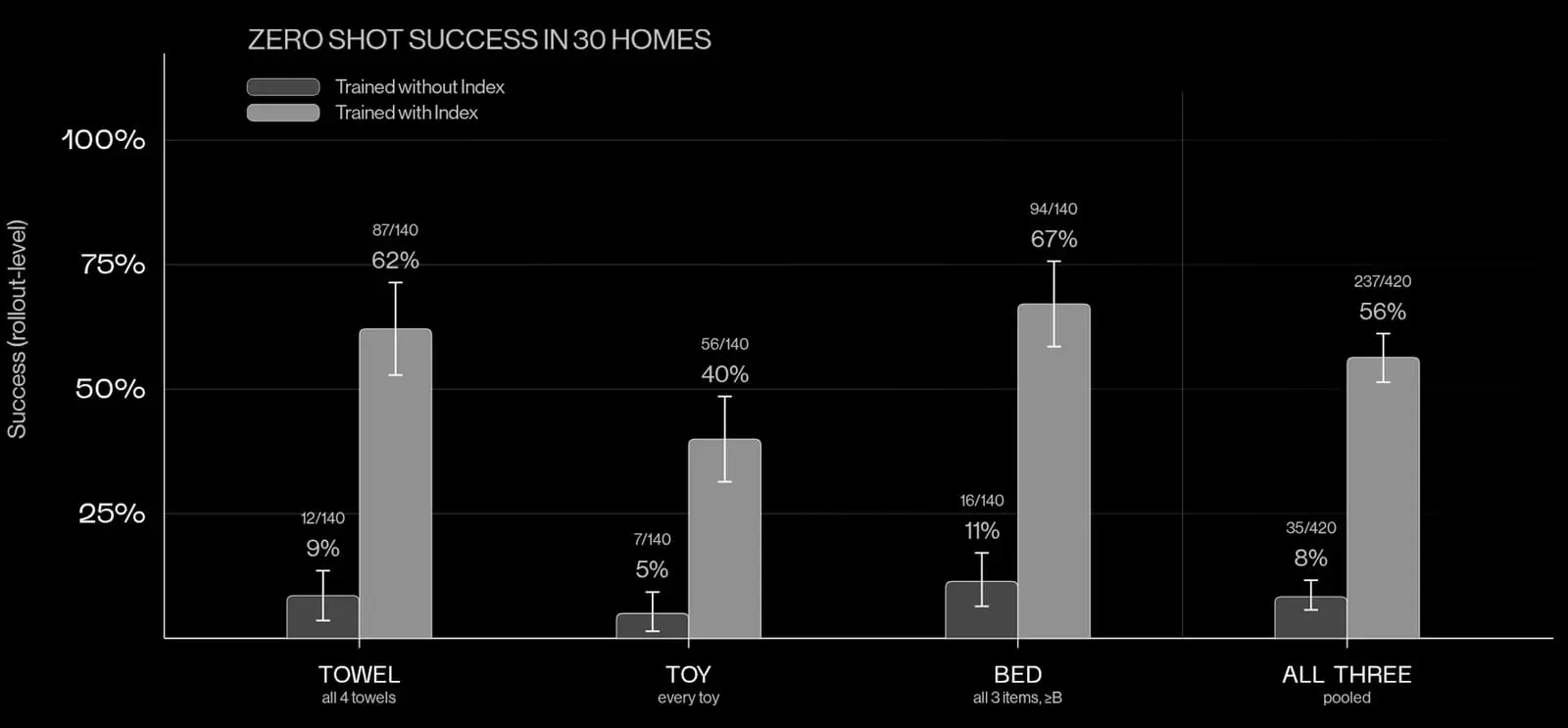
- Per task, from Figure's chart: towels 62% (87 of 140), toys 40% (56 of 140), bed making 67% (94 of 140)
What Figure announced
Figure published Helix 2.5 on 17 September 2026, describing it as the most advanced neural network it has built. Unlike Helix 02, which started from a pretrained vision-language model, Helix 2.5 was pretrained from random initialisation entirely on Index, Figure's dataset of human behaviour. Figure says Index generates roughly 35 minutes of new human experience every second. One Index-pretrained base model was then adapted to three behaviours: tidying living rooms, folding towels and making beds.
The evaluation used 30 Bay Area homes the model had never seen, with zero data collected in any of them and a single fixed checkpoint per task across all homes. A run counted as a success only if the whole task was finished, for example all 13 to 15 toys placed in the basket. Rollouts that needed a safety intervention were counted as failures.
The results
Zero-shot success rose from 9% for a model trained from scratch to 56% for the Index-pretrained model, which Figure describes as more than 6x higher. Task data, architecture and training were held fixed, so Index pretraining was the only variable. Figure says no single evaluation task made up more than 1.90% of the pretraining data. Helix 2.5 also matched the success rate of a Helix 02 policy while using half as much adaptation data, and did so zero-shot across the 30 homes.
Figure also reports a scaling result. Four models were trained on nested Index subsets spanning an 8x increase in data, and the team says it predicted the largest run's test loss to four decimal places from the smaller runs before training. The forecasting error was 0.54% of the variation across the range.
Figure's results chart adds the detail. Each task was run 140 times, 420 in total. With Index pretraining the robot folded all four towels in 62% of runs, put away every toy in 40% and made the bed in 67%, for a pooled 237 of 420. The model trained from scratch managed 9%, 5% and 11%. Its pooled bar reads 35 of 420, or 8%, while the text of the post says 9%.
What changed for humanoid developers
Helix 02 started from a pretrained vision-language model. Figure's new result argues that pretraining on recorded human behaviour alone can produce a base model that generalises to new homes. The jump to 56% is large, but it also means the robot failed on almost half of the attempts, and toy tidying still fails in most runs. The robot model used is not named in the post. Figure has committed $3.5 billion of compute to Helix, which matches the Nscale deal for up to 100,000 Vera Rubin GPUs announced two weeks earlier.
What to watch next
Open questions are model size, the number of homes per task, and whether the scaling law holds beyond the 8x range tested. Commercial deployment in homes is not discussed in the post. Other humanoid programmes are tracked under Robotics & Physical AI.
What changed
| Before | Helix 02 was trained on data from the environment where it was evaluated and started from a pretrained vision-language model |
|---|---|
| After | Helix 2.5 is pretrained only on human behaviour data and completes tasks in 30 unseen homes 56% of the time zero-shot |
| Who it affects | Developers of humanoid and household robots, and researchers working on robot foundation models |
Questions people ask
- What is Figure Helix 2.5?
- Figure's humanoid robot model announced on 17 September 2026, pretrained from scratch on Index, a dataset of human behaviour, and adapted to household tasks.
- How well did Helix 2.5 do in new homes?
- Figure reports 56% zero-shot success across 30 unseen homes on tidying, towel folding and bed making, compared with 9% for a model trained without Index pretraining.
- Which robot ran Helix 2.5?
- Not stated in the announcement.
- How many trials did Figure run?
- Figure's results chart shows 140 runs per task and 420 in total, with 237 successes for the Index-pretrained model.
Sources
- Helix 2.5: Zero-Shot 30-Home Generalization (Figure, 17 Sep 2026)
Reference pages
- Figure company
Spotted an error? See the corrections policy and tell the editor. Facts in this story come from the sources listed above; vendor claims are attributed.
Comments
Loading comments.