Opera ships local AI models in Opera One with WebAI, free and opt-in for sites and extensions
Opera began shipping local AI models in its browsers on 27 October 2026. WebAI lets sites and extensions run Gemma and other models on the user's own PC.
By Emre AlemdarPublished
 Tech AI Latest
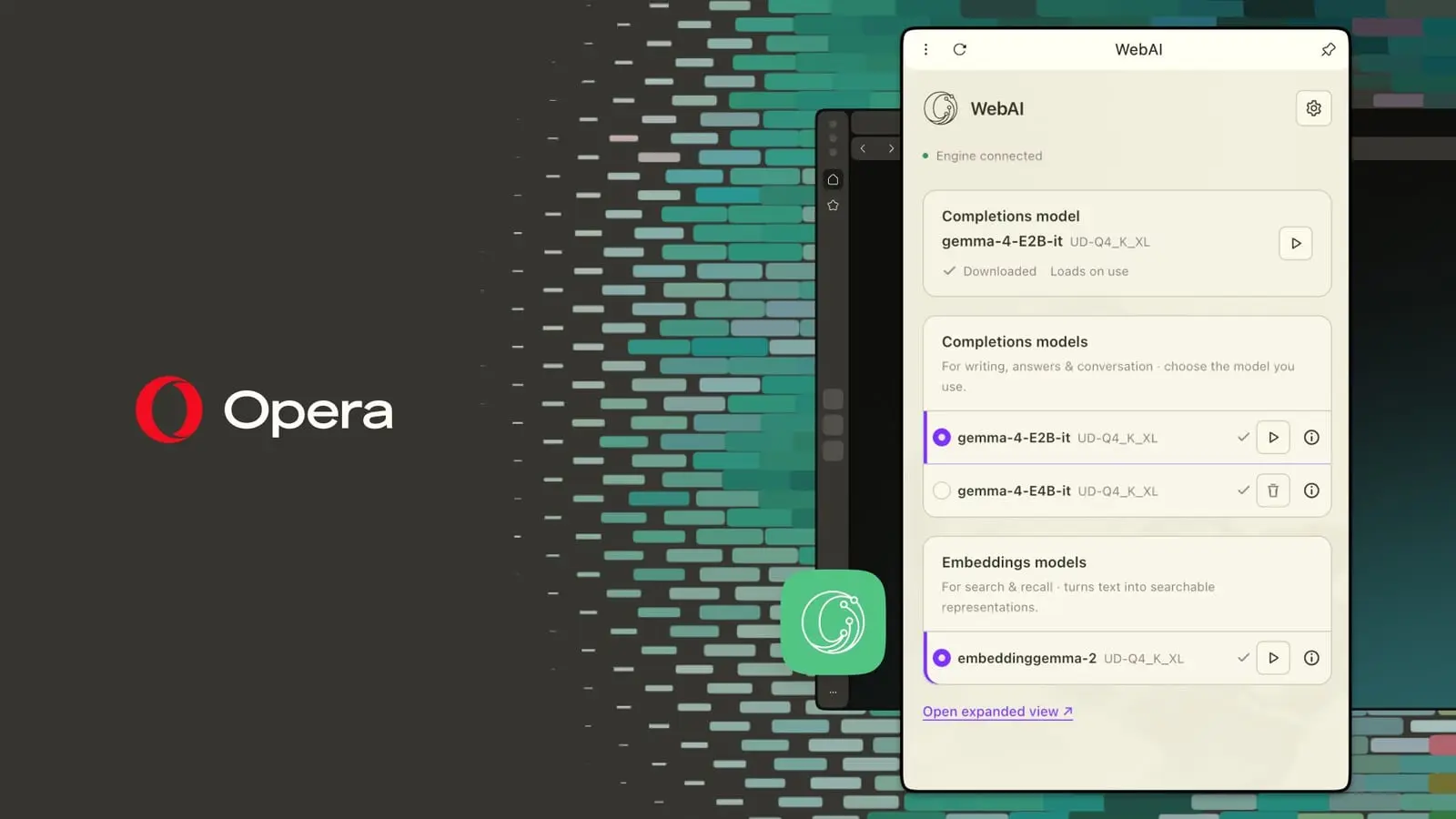
Opera began shipping local AI models on 27 October 2026 with WebAI, an opt-in early preview in Opera One. Websites and extensions can call Prompt, Decision and Semantic Embeddings APIs that run on the user's own computer, using open-weight models such as Google's Gemma or Apple's on-device model on Macs. Opera says there is no account, fee or API key. It works on 64-bit Windows PCs and Apple silicon Macs, with Opera GX and Opera Neon to follow.
Key facts
- Announced: 27 October 2026 (Opera press release and Opera blog)
- Status: opt-in early preview in Opera One; Opera GX and Opera Neon to follow, per the press release
- APIs: Prompt, Decision and Semantic Embeddings for websites and extensions
- Models: open-weight models through Opera, including Google's Gemma; Apple's on-device foundation model on Macs
- Platforms: 64-bit Windows PCs (Intel or AMD) and Apple silicon Macs; not Intel Macs, Linux or Windows on Arm
- Price: free; Opera says no account, fee or AI subscription is needed
What Opera announced
Opera said on 27 October 2026 that it began shipping local AI models in its browsers, starting with WebAI as an early preview in Opera One. WebAI is a proposed web standard, which Opera says is backed by companies such as Google and Microsoft, that lets websites and browser extensions use AI hosted through the browser. Opera's version is model-agnostic. At launch it offers Google's Gemma models and, on Macs, Apple's on-device foundation model.
The Opera blog post lists three developer interfaces: the Prompt, Decision and Semantic Embeddings APIs, for generating text, classifying information and finding links between pieces of content. Opera released six experimental extensions to show the idea, such as one that rates each paragraph of an article by how much it matters to a user's project and one that writes a quiz about the page just read. Opera says these are examples, not Opera features.
Where it runs and what it costs
WebAI is opt-in. Nothing is downloaded until the user goes to Settings, then Opera AI, and turns on Enable Web AI API, which fetches a compatible local model and can take a few minutes. Site-specific permissions decide which websites can use the local model. The preview runs on 64-bit Windows PCs with Intel or AMD chips and on Macs with Apple silicon. It is not available on Intel Macs, Linux or Windows on Arm, and Opera notes that speed depends on the user's hardware.
Opera does not charge for it. The company says users need no AI subscription and developers need no API key, no local server and no AI infrastructure, and pay nothing per request. Because inference runs on the computer, Opera says the content the model processes does not have to be sent to a cloud AI provider. The press release says GX and Neon will follow Opera One, while the blog post describes the preview as already spanning Opera One, Opera GX and Opera Neon.
What changed and why it matters
Opera first offered local models in an experimental developer build in April 2024. The change is that local inference now ships in the main browser for everyone who opts in, and that pages and extensions, not only a built-in chat, can call it. For developers, that moves some AI features from paid cloud APIs to free on-device models, at the cost of smaller models and uneven performance across hardware. Krystian Kolondra, EVP Browsers and AI at Opera, said more models and tools are coming.
What to watch next
Open questions are which other browsers ship the WebAI proposal, which model sizes Opera will add for different devices, and when GX and Neon get the feature. The announcement gives no date for general availability. The same release also launched HTML-in-Canvas, which places live web pages inside 2D and 3D scenes. Other desktop assistant updates, such as the ChatGPT desktop app update, are listed under AI Tools.
What changed
| Before | Local models were available only in an experimental Opera developer build since April 2024 |
|---|---|
| After | WebAI ships as an opt-in early preview in Opera One with free local models and Prompt, Decision and Semantic Embeddings APIs |
| Who it affects | Opera One users on Windows and Apple silicon Macs; web and extension developers who want on-device AI without per-request costs |
Questions people ask
- Is Opera WebAI free?
- Yes. Opera says users need no AI subscription or account and developers need no API key, and there are no per-request cloud costs because the model runs on the user's computer.
- Which models does Opera WebAI use?
- At launch, open-weight models provided through Opera, including Google's Gemma, and Apple's on-device foundation model on Macs, according to Opera's press release.
- Which computers support Opera WebAI?
- 64-bit Windows PCs with Intel or AMD chips and Macs with Apple silicon. Opera says it is not available on Intel-based Macs, Linux or Windows on Arm.
Sources
- Opera doubles down on local AI, shipping models directly in its browsers (Opera Newsroom, 27 Oct 2026)
- WebAI: Local AI for the web, now in Opera (Opera Blog, 27 Oct 2026)
- WebAI developer documentation (Opera, 27 Oct 2026)
Reference pages
- Opera company
- Opera WebAI tool
Spotted an error? See the corrections policy and tell the editor. Facts in this story come from the sources listed above; vendor claims are attributed.
Comments
Loading comments.