GitHub makes Agentic Workflows generally available and lets teams share Copilot Automations
GitHub made Agentic Workflows generally available at Universe on 28 October 2026 and is rolling out shared Copilot Automations that bill the repository owner.
By Emre A.Published
 Tech AI Latest
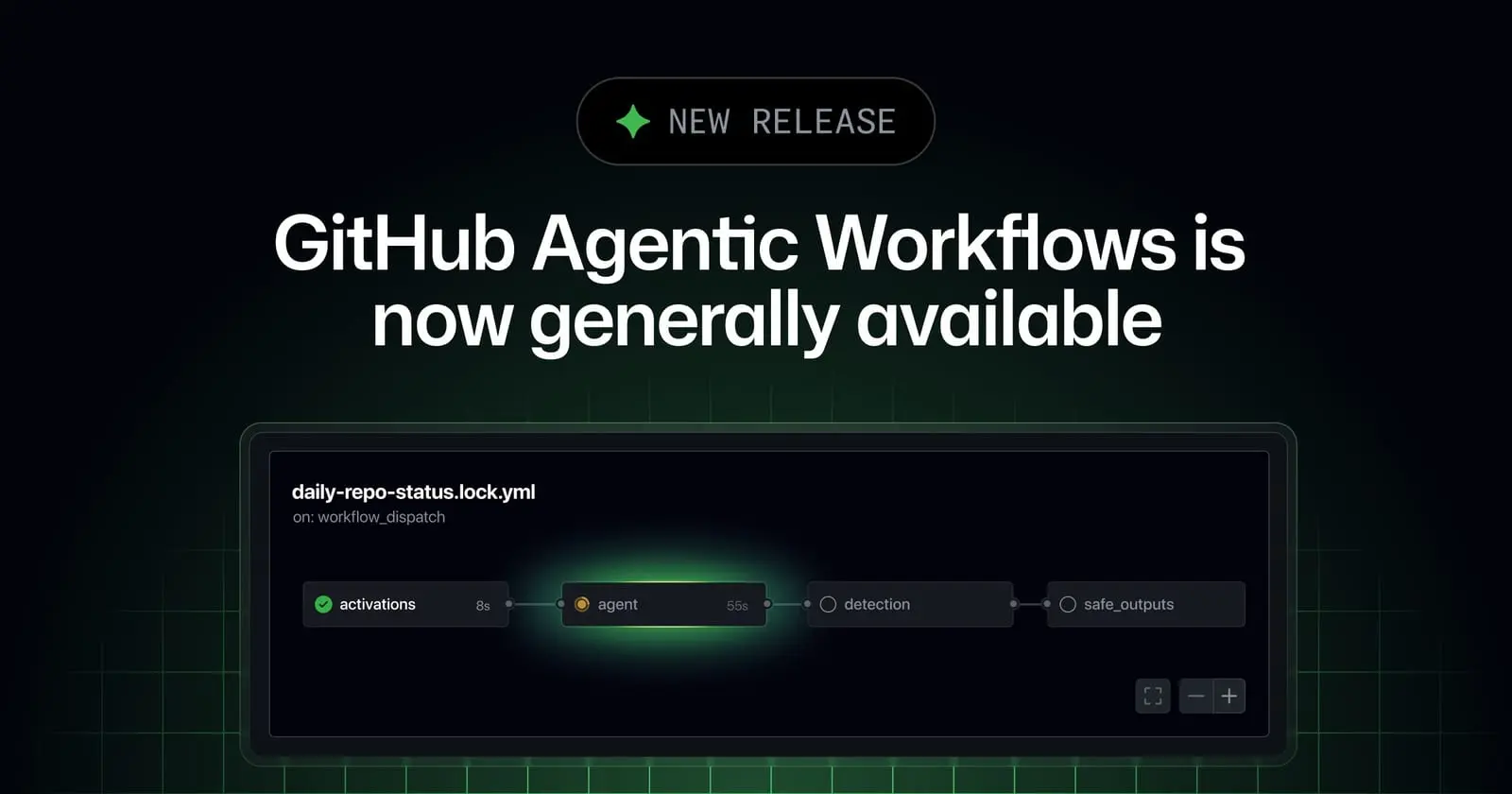
At GitHub Universe on 28 October 2026, GitHub made Agentic Workflows generally available for Free, Team and Enterprise accounts. The open-source tool turns Markdown task descriptions into GitHub Actions workflows that run a coding agent in a sandbox. GitHub also started rolling out shared Copilot Automations, which belong to a repository, act as Copilot and bill AI credits to the repository owner rather than the person who created them.
Key facts
- Announced: 28 October 2026 at GitHub Universe (GitHub changelog)
- Agentic Workflows: generally available on github.com for Free, Team and Enterprise
- Default engine: GitHub Copilot CLI, which needs a Copilot licence; other agents allowed
- Agents run read-only by default in a sandbox behind the Agent Workflow Firewall
- Shared Copilot Automations: rolling out to Pro, Pro+, Max, Business and Enterprise plans
- Shared automations bill AI credits to the repository owner and act as Copilot
What GitHub announced
GitHub used its Universe conference on 28 October 2026 to move two agent features forward. The first is GitHub Agentic Workflows, an open-source project from GitHub Next, which is now generally available. It runs coding agents inside GitHub Actions for tasks like issue triage, CI failure analysis, documentation updates and test writing.
Teams write each workflow in natural language in a Markdown file. The gh aw CLI compiles it into standard Actions YAML, so it reuses existing runner groups and policy rules. GitHub Copilot CLI is the default engine, which requires a Copilot licence, but teams can bring their own coding agent. GA covers github.com on the Free, Team and Enterprise plans.
Safeguards and what is new since preview
GitHub says agents read GitHub content through integrity filter rules, run with read-only permissions by default and execute inside a sandboxed container behind what it calls the Agent Workflow Firewall. Their outputs pass a validation step before anything is written back. Since the public preview, GitHub has added support for self-hosted Actions Runner Controller runners with Docker-in-Docker, a stable gh aw forecast command for estimating monthly AI credit spend, per-workflow choice of model provider, a model router and the option to isolate agents in Cloud Hypervisor or NVX micro-VMs.
The changelog quotes Accenture, which says one lead saved about 29 hours a week and that AI now writes 91% of a team's commits. Those are customer claims that GitHub did not independently verify in the post.
Shared Copilot Automations
The second change is shared Copilot Automations. Automations combine a prompt, triggers and allowed tools, and run Copilot in the cloud, for example to reproduce a bug when an issue opens or to investigate an incident from a monitoring alert. Until now they were personal and used the creator's identity and AI credits.
Shared automations belong to the repository. Anyone with read access can see them, anyone with write access can edit them, actions on GitHub are attributed to Copilot, and AI credits are billed to the organization or user that owns the repository. They keep running if the creator leaves. In organization repositories an administrator must first enable the policy that bills Copilot cloud agent use to the organization. The type cannot be changed after creation.
Why it matters and what to watch
Both features turn agents from something one developer runs into shared team infrastructure with owners, budgets and audit trails. That follows GitHub's earlier work on local sandboxing and computer use. GitHub also said Enterprise customers can now use all Copilot features without a separate subscription and pay for the AI credits they use. Watch how credit costs add up once triage and CI agents run on every event. More agent framework news is on the AI Agents hub.
What changed
| Before | Agentic Workflows was in public preview, and Copilot Automations were personal, billed to and acting as the user who created them |
|---|---|
| After | Agentic Workflows is generally available; shared Copilot Automations belong to a repository, act as Copilot and bill the repository owner |
| Who it affects | Teams using GitHub Actions and Copilot on Free, Team, Enterprise and paid Copilot plans; organization admins who set Copilot billing policy |
Questions people ask
- Is GitHub Agentic Workflows free?
- It is open source and generally available on GitHub Free, Team and Enterprise. Running it with the default Copilot CLI engine requires a Copilot licence and uses AI credits.
- Who pays for shared Copilot Automations?
- The organization or user that owns the repository, not the person who created the automation, according to GitHub's changelog.
- Which plans get shared Copilot Automations?
- GitHub says they are rolling out to Copilot Pro, Pro+, Max, Business and Enterprise plans, and availability may vary during the rollout.
Sources
- GitHub Agentic Workflows generally available (GitHub Changelog, 28 Oct 2026)
- Build shared workflows for your team with Copilot Automations (GitHub Changelog, 28 Oct 2026)
- GitHub Universe 2026: Evolving every layer of the stack (GitHub Blog, 28 Oct 2026)
- github/gh-aw repository (GitHub, 28 Oct 2026)
Reference pages
- GitHub company
- Microsoft company
- GitHub Agentic Workflows tool
- GitHub Copilot tool
Spotted an error? See the corrections policy and tell the editor. Facts in this story come from the sources listed above; vendor claims are attributed.
Comments
Loading comments.